Introduction: Projectile motion is one of the most important topics in Physics, taught in almost every high school syllabus including A-Levels, IB and other curricula. But many students only memorize formulas for range, time, and height—without ever understanding the motion itself. In this blog, we will break down the ideas behind projectile motion so clearly that even if you’ve struggled before, you’ll finally see how it all fits together.
We’ll look at what makes projectile motion unique, how to model it using kinematics, what assumptions are made in solving such problems, and how it connects to real-world applications.
What Is Projectile Motion?
Projectile motion is the motion of an object thrown or projected into the air, subject only to the force of gravity (ignoring air resistance). This means once the object is released, the only force acting on it is gravity pulling it downward.
Examples include:
- A football kicked at an angle
- A cannonball fired from a cliff
- A water stream from a hose
- A basketball in a free-throw shot
The key characteristic of projectile motion is that it follows a curved path, called a parabola.
Decomposing Motion:
Horizontal vs Vertical: One of the most important ideas is that projectile motion can be split into two separate motions:
- Horizontal motion (x-axis): constant velocity, because there is no horizontal force (no air drag).
- Vertical motion (y-axis): accelerated motion due to gravity, which causes the object to slow down as it rises and speed up as it falls.
These two motions are connected only by time. This separation is what makes solving problems easier using standard kinematic equations:
Vertical motion (with acceleration): 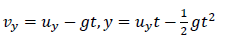
Horizontal motion (constant velocity):
Assumptions Behind the Model
Before we dive into solving projectile motion problems, it’s important to know that we’re using a simplified model. These assumptions help us focus on the core physics without getting lost in complicated math or unpredictable real-world effects.
We explain each of these assumptions in detail in our blog: Projectile Motion 03 – Assumptions in Projectile Motion
Here’s a quick overview:
| Assumption | Why We Use It | What If We Don’t? |
| No air resistance | Keeps equations simple and motion symmetrical. | Trajectory becomes uneven, horizontal velocity decreases, complex math needed. |
| Constant gravity (g = 9.8 m/s²) | Gravity is nearly constant near Earth’s surface. | We’d need to model varying gravity using advanced equations (e.g. g(h)). |
| Flat Earth approximation | Valid for short distances (<10 km); avoids complex geometry. | Requires spherical geometry and Earth’s curvature correction. |
| Motion in 2D (x-y plane) | Allows us to break motion into horizontal and vertical components. | We’d need 3D vector calculus to model real trajectories. |
| Horizontal and vertical motions are independent | Time is the only shared variable; makes kinematics manageable. | Real-world forces (like wind, spin) mix motions; harder to solve separately. |
| No spin or rotation | Removes effects like curve balls or lift (Magnus effect). | Requires fluid dynamics and aerodynamic modelling. |
| No rebound or bounce | Simplifies motion as ending at first contact. | Must include energy loss, coefficient of restitution, and collision laws. |
Shape of the Trajectory When we plot the path of a projectile, it forms a curved arc called a parabola. That’s because the vertical motion changes over time due to gravity, while the horizontal motion stays the same.
The equations of motion predict this curve: 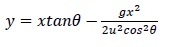
This equation represents the projectile’s trajectory, and it shows:
- The object rises, slows down, stops briefly at the top (highest point), then falls.
- The total time and range depend on the angle of projection.
- The curve is symmetrical only under ideal conditions (as per our assumptions).
Important Quantities to Remember
For an object projected at an angle θ with initial speed u:
Time of Flight (total time in air): 
Maximum Height (vertical height): 
Horizontal Range (distance covered): 
These equations are derived under the assumptions listed earlier. If those assumptions change, so do these formulas.
Real-Life Applications
- In sports: Basketball, football, and cricket all involve curved trajectories.
- In engineering: Ballistics, missile targeting, and drone launches use projectile equations.
- In physics experiments: Lab demonstrations often use projectile motion to study acceleration and forces.
Even video games and animation software simulate projectile motion to mimic real-world physics.
Common Student Misconceptions
- Believing horizontal velocity decreases (it doesn’t, if no air resistance).
- Thinking the object stops at the top (vertical velocity is zero, not total velocity).
- Confusing the independence of motion: vertical acceleration does not affect horizontal motion.
Fixing these misunderstandings can make solving problems much easier and help build intuition.
Final Thoughts Projectile motion isn’t just about memorizing formulas—it’s about visualizing how forces and motion interact in two dimensions. By learning how to break motion down, apply the right equations, and understand the limits of our models, you develop problem-solving skills that apply across physics.
In our next blog, we’ll take this theory and derive the results step-by-step in Projectile Motion 02 – Derivations and Key Results. See you there!