Introduction
Now that we’ve explored the theory and concepts behind projectile motion, it’s time to derive the most important results. In this blog, we’ll walk step-by-step through the derivations of time of flight, maximum height, horizontal range, and the equation of the trajectory.
By understanding where these equations come from—not just memorizing them—you’ll be better equipped to apply them to real problems and grasp the physics behind the motion.
1. Setup: Oblique Projection
We consider an object launched from the ground with:
- Initial speed: u
- Angle of projection: θ
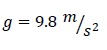
- Acceleration due to gravity:
We break the initial velocity into components:
- Horizontal:

- Vertical:

2. Time of Flight (T)
This is the total time the projectile stays in the air. Since the vertical displacement is zero when it returns to ground:
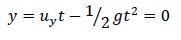
Substituting  gives us
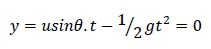
Solving the quadratic equation in t gives us two roots –
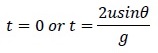
So what does t=0 mean?
It represents the moment the projectile was launched – the starting point of the motion. This is important to understand: time t starts counting from the instant of launch.
If we try to interpret t=0 as any point later during the motion, it would wrongly suggest that the object is moving while time hasn’t progressed, which doesn’t make sense. That’s why we don’t ignore the solution t=0 – we recognize that it marks the beginning of the motion.
The second root  , tells us the time when the projectile returns to the same vertical level (typically the ground). That’s the total time the object is in the air – called the time of flight, usually denoted as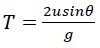
3. Maximum Height (H)
At maximum height, vertical velocity becomes zero:

t’ is the time taken by the projectile from the launch to reach the maximum vertical height where 
Substitute into vertical displacement:
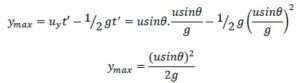
4. Horizontal Range (R)
Horizontal range is total horizontal distance covered:
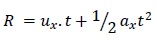
We know that air resistance is negligible, therefore 

5. Equation of the Trajectory
We want to find an equation of the form  eliminating time.
From horizontal motion: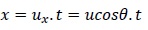

Substitute into vertical equation:
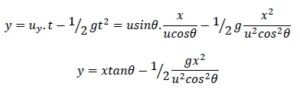
This is the equation of a parabola, confirming the curved trajectory.
6. Summary of Key Results
| Quantity | Formula |
| Time of Flight | |
| Maximum Height |  |
| Horizontal Range |  |
| Equation of Path | 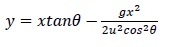 |
7. What’s Next?
We now understand how the equations of projectile motion are derived. In the next blog, we’ll connect these results to the assumptions that make them valid.
👉 Read next: Projectile Motion 03 – Assumptions in Projectile Motion
After that, we’ll head into some real problem-solving examples in Blog 04!